
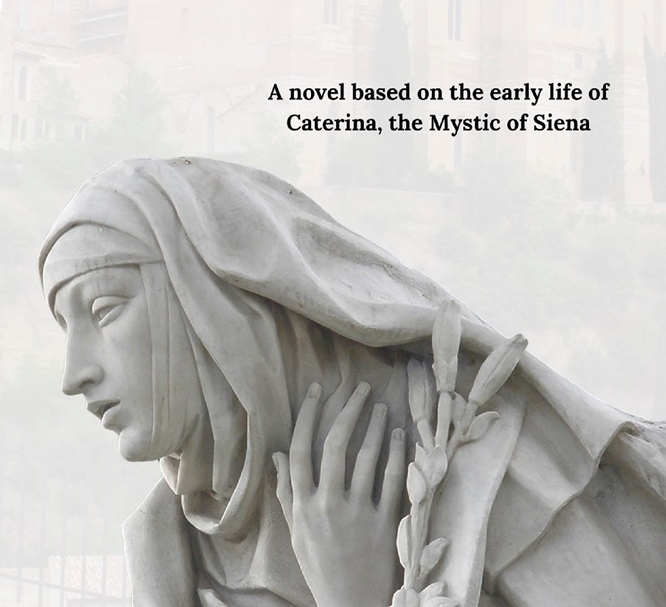

Novel as Veneration: Jenny duBay’s World Between Worlds
By Franci Revel Eckensberger, Lead Editor
Before I believed that Jesus Christ was anything more than a wise teacher, I had a deep interest in St. Catherine of Siena for one reason—her anorexia.
Or rather, her “anorexia” as I understood it. For some reason, none of my feminist leanings drew me to the brilliance of her mind or the scope of her accomplishments, except insofar as they orbited her disease. It wasn’t her counsel to the popes, her extraordinary letters, or her self-determination, all amid a nearly total lack of formal schooling. It was always simply her refusal to eat. Her Eucharistic sustenance did not intrigue me—her lack of all other nutrition did.

I think I saw in Catherine a mirror for my own obsessions. I was drawn to her unrestrained intensity but wholly uninterested in its source, its aim, its focus . . . That she was a saint at all was more incidental than the central aspect of her identity.
“You can’t study the life of a Christian mystic for very long before you find yourself back in the Church,” Jenny duBay recently told Paloma & Fig. She would know, having immersed herself in Catherine’s writings and the landscape of Siena itself to write World Between Worlds, a lush and sprawling novel of the saint’s early life. This immersion brought duBay back to God–in her words, she moved from understanding Christ as a “wonderful prophet” to understanding Him as the Son of God by way of reading Catherine’s work. That particular power of Catherine’s is brought to life in this novel.
In duBay’s vivid Siena, we’re placed in a medieval atmosphere of church bells and incense drifting on the air, candles flickering over a tumultuous childbirth, the austerity of the curia a setting all its own. Plague stalks the entire work and infuses the mystical with inevitable mortality. We touch the raw wool that Catherine’s father dyes for a living and feel the arid heat of a city in perpetual drought, inhabited by a people marked by war and political turmoil. Though focused on Catherine’s young life, World Between Worlds lays the foundation for everything that is to follow. The woman who would go on to help return the papacy to Rome and change countless lives across centuries is illustrated by duBay with honor and curiosity. Humanized yet never diminished from her saintly status, this Catherine fears her own selfishness, navigates her lack of formal education, and is acutely attentive to others’ perceptions. She is given a self-consciousness and a rich private life that doesn’t tip into hagiographic flatness or tedium.
The reader is dropped immediately into a decidedly female story, one that begins with a visceral scene of childbirth and maintains throughout a keen awareness of the tension Catherine’s gender places upon her status, as well as upon her decision to devote herself wholly to Christ at age seven. Sororal relationships, complex mothers, and the pressures of marriage and motherhood all bear down upon the young women of Siena, and duBay displays an implicit understanding of why Catherine speaks so clearly to modern women despite remaining so thoroughly, intriguingly medieval.
Looking at olive trees growing in “huddled clusters” beside her home, Catherine reflects on her lot in life: “Everyone knows that a person carrying such a branch is asking for reconciliation, for brotherly love, for tranquility. Yet what good does a silent symbol do in this world, in this city seething with revolt and revenge, but not renewal? I want to go out into the streets, but my mother objects.”1 In alternating chapters, the perspective shifts away from Catherine, allowing us to see her as others do but also to stay grounded in the setting of her time and the reverberations of her actions. It is never myopic, and in that way it respects the manner in which Catherine lived. It would be very easy to take a mystic’s life and produce a novel that accidentally locks the reader out by drowning us in her visions and asceticism. duBay’s Catherine is called outward:

“Now that the First Truth has shown me my interior cell, the cell of self-knowledge, the mystical union with the Spirit which is always with me . . . I am to go out, into the world.”2
The book is propelled by this closeness to Christ, the very closeness that causes some of Catherine’s contemporaries to suspect her of possession, vanity, or mania. “I am not here,” she says, “yet I am. I’m everywhere. With my Beloved, my Lord and my God, I am everywhere.”3 duBay allows you to swim in this unmatched intimacy Catherine has with her Creator—”His breath fragrant like myrrh,”4 His heart a place to dwell and “live forever”5—with such intensity that you are spurred to seek similar closeness, or at least left longing for it. It is often as saturating as the sounds of medieval chant. And Catherine’s identity is located not within this intoxication of the mystical experience itself but within its object: the First Truth, my favorite of her names for Christ.
“At peace, united, of the same substance and grace as the First Truth. Two become a single essence.”6
The saints, Catherine among them, love the Eucharist and the Cross first, and it is in the dwelling of that love that they come to love and serve every suffering or difficult person in front of them. I didn’t understand this when I first came to Catherine. As I continued engaging with her, I experienced a very close conversion to that described by duBay through Catherine’s writings. This novel embodies what I came to see: the closer Catherine the mystic is drawn to Christ, the larger her capacity for the world becomes, and the more profound her desire for all souls to be saved. The heart that loves God doesn’t furl you into dark caverns, producing an interior intensity for the sake of isolation. Reading this novel, I was reminded of the freedom I felt when I gradually became less interested in what Catherine’s bodily suffering resembled to me and more interested in the shape of her love, which takes form early on in these pages.
On the subject of her fasting, duBay’s Catherine says she barely understands it herself: “I have to empty myself completely in order to be receptive to Divine inspiration. It’s the only way. At least, it’s the only way I know right now.”7 duBay’s world does not shelter us from the visceral nature of medieval spiritual understanding, foreign and perhaps disturbing or scandalizing to us. The novel lets Catherine’s extraordinary practices be legible only in one context, which is always and irreducibly the love of Christ. I am reminded here of the earlier reflection—What good does a symbol do? What I once understood as a symbolic practice sustaining Catherine’s ascetic life within her own image gives way to a reliance on the living Bread—the Eucharist—in which Christ gives not a sign but His very self, in whose image her being is made. Catherine’s fasting is not about self-erasure as an end in itself or a psychic performance, but about making space for the One to whom her life is ordered and making herself an image-bearer: I am she who is not.8 In World Between Worlds, we get to see how it might look and feel to live that statement. As readers, we participate in this reverence.
duBay’s writing is epic, fervent and painterly in its detail, tender and moving in individual scenes and in overall effect. Historical novels, especially those set in medieval times, can so often feel canned or ballooning with facts, lacking the power we ask of fiction to go beyond information and into transformation. This one does not. duBay has inhabited the world and mind of her character such that her extensive research has emulsified into a living story. Its heart has a beat, and it’s almost like novel as veneration. Honest and dramatic, it both educated me and moved me to tears on more than one occasion, particularly when it dipped into such achingly reverent, personal language from Catherine to Christ that I felt almost forced to stop reading and begin praying myself.
For this reason, I’m inclined to also call it novel as evangelization.
In his Letter to Women, St. John Paul II named Catherine directly, holding her up alongside Teresa of Ávila as evidence of what he called the feminine genius, the particular gift women bring to the Church and to the world. He wrote that women see persons “with their hearts,” independently of systems or ideologies. Catherine did this, and as a novelist, duBay does, too. Near the end, a character asks whether Catherine, “a simple woman,” can really assist a cardinal of the Sacred College. The cardinal’s response is the answer the book has been building toward and the one we know to be true from our current vantage in 2026:
“Who else?”
Visit Jenny duBay’s website here to learn more about her work as an author and trauma-informed coach helping women navigate betrayal, trauma, or spiritual wounds. Her mission is to help survivors of domestic abuse and betrayal trauma reclaim their lives. Her nonfiction books focus on hope, healing, and renewal. World Between Worlds is her first novel and is available now from En Route Books & Media.
- Jenny duBay, World Between Worlds, 259 ↩︎
- duBay, 172 ↩︎
- duBay, 55 ↩︎
- duBay, 172 ↩︎
- duBay, 148 ↩︎
- duBay, 171 ↩︎
- duBay, 149 ↩︎
- Do you know, daughter who you are and who I am? If you know these two things you have beatitude in your grasp. You are she who is not, and I Am He Who Is. Let your soul but become penetrated with this truth, and the Enemy can never lead you astray. (Jesus to St. Catherine of Siena) ↩︎

Lead Editor Franci Revel Eckensberger holds a Master of Fine Arts in Poetry from Cornell University. With years of experience as a copyeditor for academics, fellow writers, and various small businesses, she takes pride in maintaining clarity, consistency, and beauty in each client’s voice.
Franci finds grace and insight in the Catholic Church’s rich relationship to language and invites that relationship to influence both her literary and editorial work. Saint Cecilia and Catherine of Siena continue to play a vital role in her journey to the faith as an artist. She lives in coastal Delaware with her husband and daughter.
Leave a Reply


access for free →
These professionally crafted, spiritually-inspired templates will help you create scroll-stopping posts in minutes. Skip the design struggle and share your message beautifully. Customize in Canva, post and get noticed. And yes, it's totally okay to swipe these!