
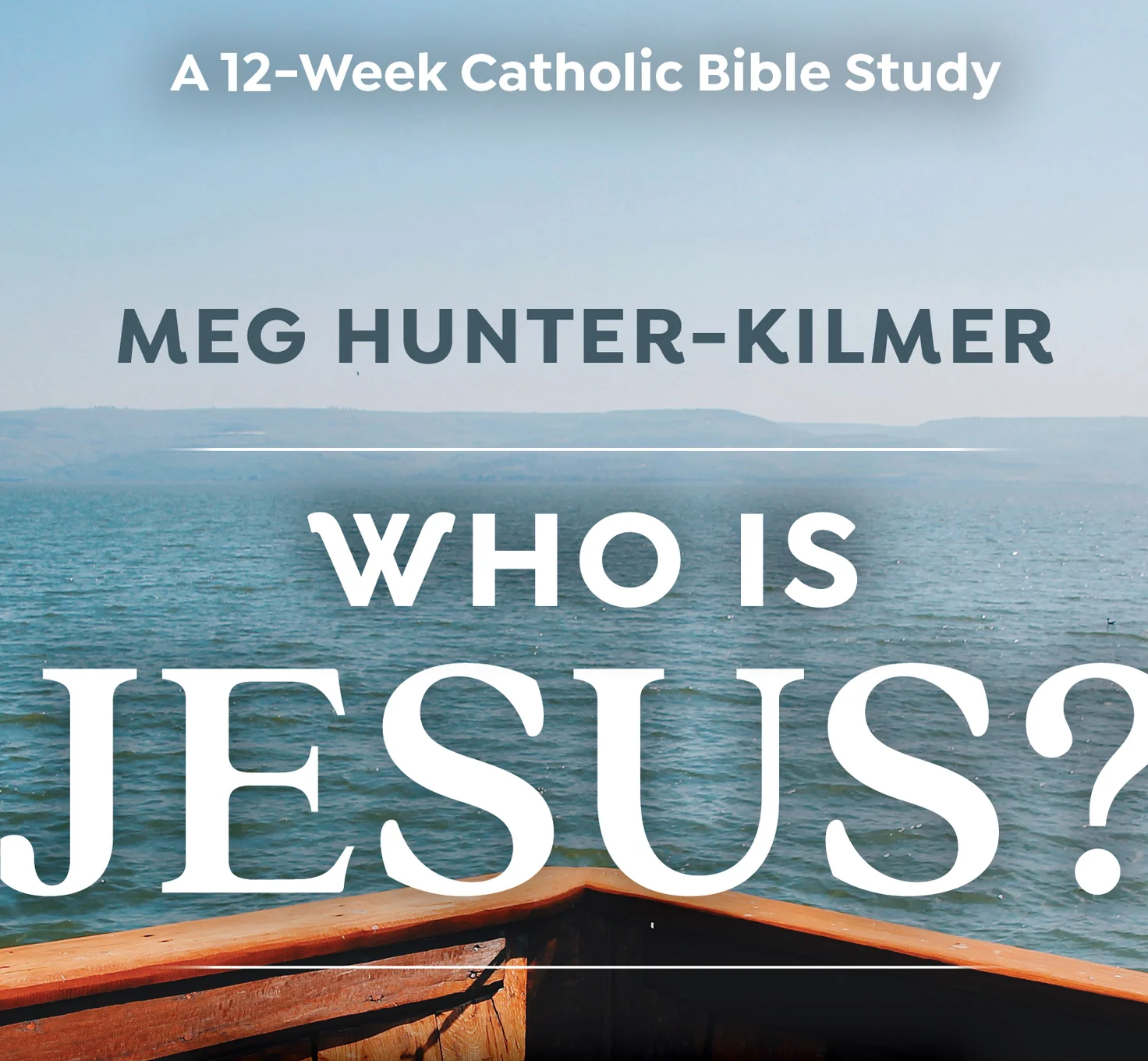

Who Is Jesus? Meg Hunter-Kilmer’s
12-Week Bible Study
By Franci Revel Eckensberger, Lead Editor
Scripture is like a river, broad and deep, shallow enough here for the lamb to go wading, but deep enough there for the elephant to swim.
—Pope St. Gregory
Meg Hunter-Kilmer opens Who Is Jesus? Discovering Christ in the Gospels with this quote from Pope St. Gregory, going on to suggest that this breadth of the Word is evidence of a God “so generous to his children” that He speaks to us in ways we can individually hear and digest—even the complete novice.
On every page, Who Is Jesus? serves as a reminder of this generosity.
This Bible study is designed for anyone and everyone: those seeking a more meditative, contemplative experience with the Gospels they know, as well as those who have never read the Bible nor encountered Christ in a meaningful way. It is a text that is not merely educational but invites its reader to transform their study into prayer. Hunter-Kilmer—who has read the entire Bible twenty times and is the author of A Year in the Word Catholic Bible Journal—helps the reader build the conditions that allow for this transformation.
The unfolding of your words gives light.
Psalm 119:130
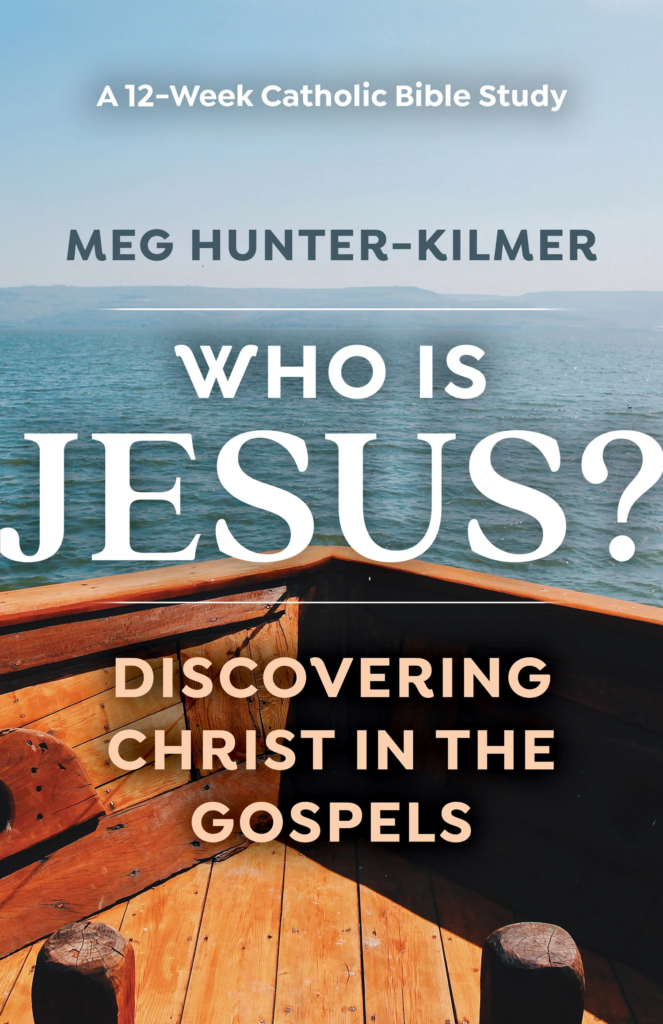
The book is structured as a twelve-week retreat, with each chapter corresponding to one week of Gospel reading and reflection, though Hunter-Kilmer leaves the pace entirely up to the reader, inviting them to craft a personal journey with God’s Word. The chapters move chronologically through Jesus’ life from the Annunciation through the glory of the Resurrection, so a natural narrative arc carries the reader forward. Each chapter opens with the Scripture citation for that week’s focus, followed by a section of “Things to Know,” one of the book’s most valuable features.
Here, Hunter-Kilmer provides a condensed version of the context a reader needs to confidently comprehend what they are encountering: Jewish law and custom, Old Testament precedents or prophecy vital to the narrative, definitions of relevant terms, and the passage’s role within the arc of Salvation history. For readers who have felt a little lost approaching Scripture—unsure of what they are missing, uncertain of the cultural or historical scaffolding—this section sets the book apart, as it does not overwhelm or condescend but also doesn’t assume theological or scholarly expertise. From there, Hunter-Kilmer poses a set of questions that she returns to each week:
What elements of this reading do you find moving? What do you find troubling? Confusing? Interesting?
These questions permit the reader to have a complicated relationship with what they are reading. Despite what Instagram might suggest, we’re not always feeling divinely inspired among a bouquet of roses and latte art when encountering God’s Word. It is normal and expected to not understand something, to be unsettled, to be unexpectedly moved—which is to say nothing of the frequent interruptions many of us experience as we try to make a daily habit of sitting with the Lord.
For group study, these questions would be particularly fruitful, giving participants concrete concerns to bring to a larger conversation and space to voice their hangups or confusions in the company of others. The book is especially well-suited to small group use, and Hunter-Kilmer includes a separate introduction with thoughtful guidance for that use. But it functions equally as a private devotional.

Someone looking for a basic timeline of the life of Christ will find it here. Someone looking to go much deeper will find that the book submerges them into that depth readily and gracefully. Who Is Jesus? evangelizes in different ways for different audiences. For every reader, it gradually funnels from the broad to the personal. After orienting us in the context of the passage and inviting initial responses, her subsequent questions often ask us to place ourselves inside the story and consider the feelings, choices, and consequences of the people present within it. She references other passages and points us to those which will further texture our understanding of Him. We are not passive observers of Jesus’ life; we are participants, invited to know Christ across time and as a constant in His own time, in our time, in all times. And not just to know Him by the facts of his life, but by His love, His miracles, and His presence and to recognize Him in our lives, hearts, and minds, here and now. By the time the reader is asked to respond from their own heart, with warmth and curiosity, they have already been face-to-face with Christ in the prior questions. They have grappled with the Word rather than simply received it, and their prayer lives are the better for it.
A favorite moment of mine comes at the end, when Hunter-Kilmer asks us, after twelve weeks of growing closer to Christ, to reflect on Thomas and the disciples’ responses to Christ’s Resurrection:
What is it like when friends of yours report spiritual experiences or seem to have stronger faith than yours? What keeps your going when you feel distant from God?
I continue to return to these two questions, which encompass a specific sort of unspoken “spiritual envy” that perhaps is, sometimes, wrapped up in doubt—if not exactly doubt in Christ, in ourselves. This final note seemed to point me right back to the book’s beginning. My answer, at this time, is that I start back on the riverbank and remind myself that my only power lies in continuing to say yes to wading in.
Who Is Jesus? is especially useful for those who might long for a personal relationship with Christ found in Scripture, yet have picked up the Bible and put it down again, over and over. Hunter-Kilmer does a wonderful job of holding your hand as you enter the place where He—the Word made flesh—is always patiently waiting.
Deep calls to deep.
Psalm 42:7
Purchase Who Is Jesus? Discovering Christ in the Gospels from Ave Maria Press here.
Learn more about Meg Hunter-Kilmer by visiting her website here.

Lead Editor Franci Revel Eckensberger holds a Master of Fine Arts in Poetry from Cornell University. With years of experience as a copyeditor for academics, fellow writers, and various small businesses, she takes pride in maintaining clarity, consistency, and beauty in each client’s voice.
Franci finds grace and insight in the Catholic Church’s rich relationship to language and invites that relationship to influence both her literary and editorial work. Saint Cecilia and Catherine of Siena continue to play a vital role in her journey to the faith as an artist. She lives in coastal Delaware with her husband and daughter.
Leave a Reply


access for free →
These professionally crafted, spiritually-inspired templates will help you create scroll-stopping posts in minutes. Skip the design struggle and share your message beautifully. Customize in Canva, post and get noticed. And yes, it's totally okay to swipe these!