


An Inheritance from Kraków to Macon
By Franci Revel Eckensberger, Lead Editor
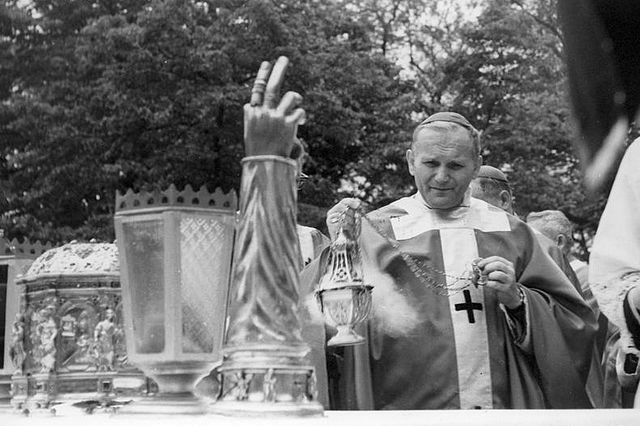
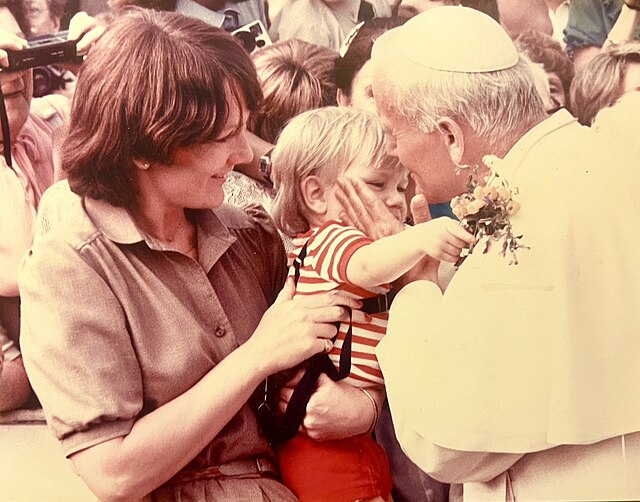
June 1979: Karol Wojtyła returns for the first time to his home country as Pope John Paul II. He is greeted by millions in Kraków, a city living under a communist regime that kept a tight hold on public religious expression. Tens of millions more hear him on the television and the radio.
Among his central themes: Saint Stanisław.
Stanisław of Szczepanów served as bishop of Kraków for seven years before King Bolesław II had him killed. As is often the case with medieval accounts, the details vary, but the story’s general shape holds fast: a bishop who rebuked and likely excommunicated an unjust, untouchable king ending in a martyrdom that Poland—and the Church at large—has never forgotten. Tradition holds that he was killed while celebrating Mass. The patron of Poland, he was canonized in 1253.
God’s instruments are not accidental. They are formed and tuned by Him within particular landscapes and at particular times—and perhaps they are especially touched by the great communion of saints dear to their specific age, place, and milieu. We are each born into different conditions—with different inheritances—for holiness. Karol Wojtyła was raised in a Poland whose spiritual life was textured by centuries of suffering and resistance, of learning to locate the presence of God through a haze of partition and occupation and unspeakable wounds. For Wojtyła, prior to the papacy, an inheritance of courage, faith, and justice was carved into the See of St. Stanisław—the office of the Bishop of Kraków. Through his appointment as Bishop and into his papacy, he returned again and again to Stanisław as the patron of a human moral order that will not bend to authoritarianism and must be upheld at any cost.
Traditional accounts tell us that after Stanisław’s body was quartered and scattered, his limbs were protected from scavengers by angels and rejoined miraculously—often seen as a providential image of Polish reunification. Even in death, Stanisław’s witness persisted, and he did not abandon his flock.
This is the inheritance John Paul II received and extended to Rome and far beyond. The pope who gave us the Theology of the Body, who championed the family, the suffering, the worker, and who allowed many to access an unprecedented understanding of human dignity awakened a renewed moral confidence in the people from whom he came. At the heart of his teaching was a conviction that the human person is not a unit of production, not a political abstraction, but a gift—and that this gift finds its origin and meaning in Jesus Christ alone:
Human life is precious because it is the gift of a God whose love is infinite; and when God gives life, it is for ever.
—St. John Paul II
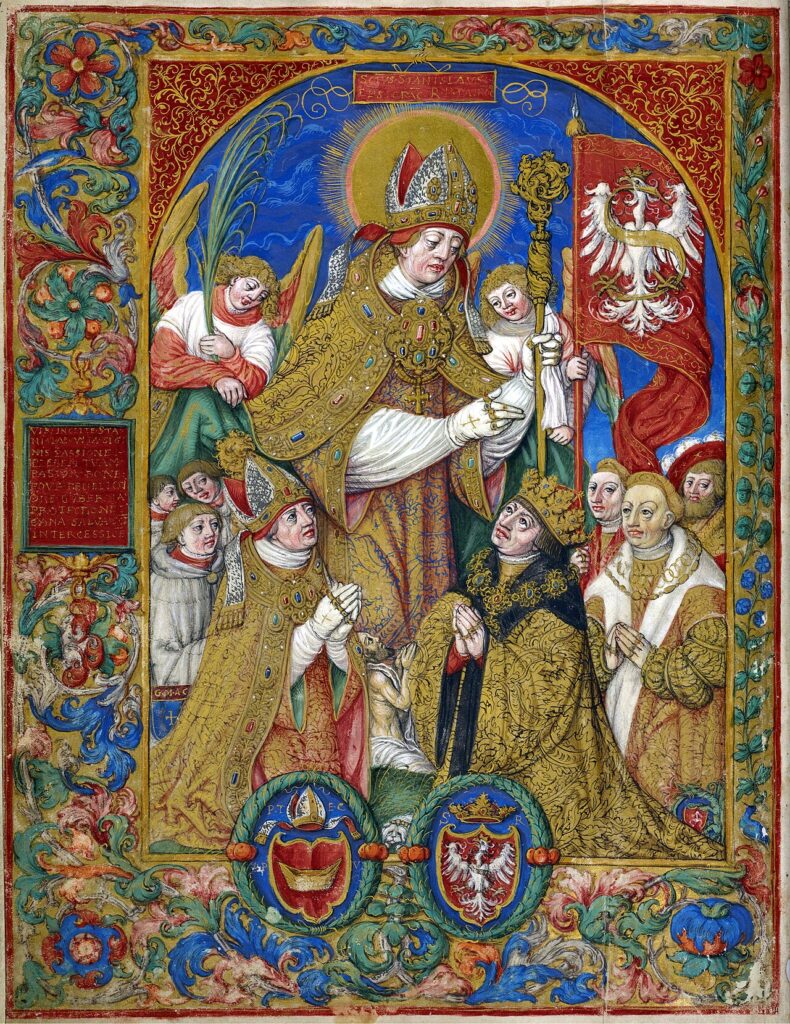
John Paul II proclaimed to the world the same fearless culture of life that Stanisław proclaimed in the face of death, while celebrating the life-giving power of the Blessed Sacrament—his own sacrifice taking place in the exact space where he honored and remembered the sacrifice of his Savior, who is the source of all life. Before communist regimes and consumerist powers alike, before crowds of millions and before individual men and women in their suffering, whom he insisted on meeting face to face, St. John Paul II proclaimed:
Be not afraid.
This phrase, spoken on that same trip to Poland, became his signature, the time-tested utterance of a man who had seen what human cruelty can accomplish and chose to occupy a disposition of hope. This testimony—born not from shallow happiness but from the deep well of suffering that is, most mysteriously, the great wellspring of our joy—is also his inheritance from St. Stanislaw. Stanisław stood between his king and the people the king was consuming. John Paul II stood between systems that decided to severely reduce humanity and a world that was losing its foothold on why that decision was monstrous. What power tries to fragment, God makes whole. It’s the same story, told again and again in the grammar of a God who does not abandon what He has made.
When John Paul II arrived in Kraków in 1979, he came as a pastor. He also came, in some sense, as Stanisław’s successor, formed in the same soil, anchored in the same conviction that human life is not a concession the state makes to its citizens but a dignity that precedes any and all earthly authority, precedes every right. In His image we struggle and in His image we prevail!
John Paul II called the Polish to resist the regime that had overtaken their nation: Be not afraid.
In response, the crowds cheered:
We want God! We want God!
On the west side of Macon, Georgia, a neighborhood celebrates its hundredth anniversary this year. The homes are historic and wide-ranging in style, from cottages to mansions. Flipping through old photographs and postcards of the city, one comes across a stately gate bearing a familiar monogram at its center: IHS.
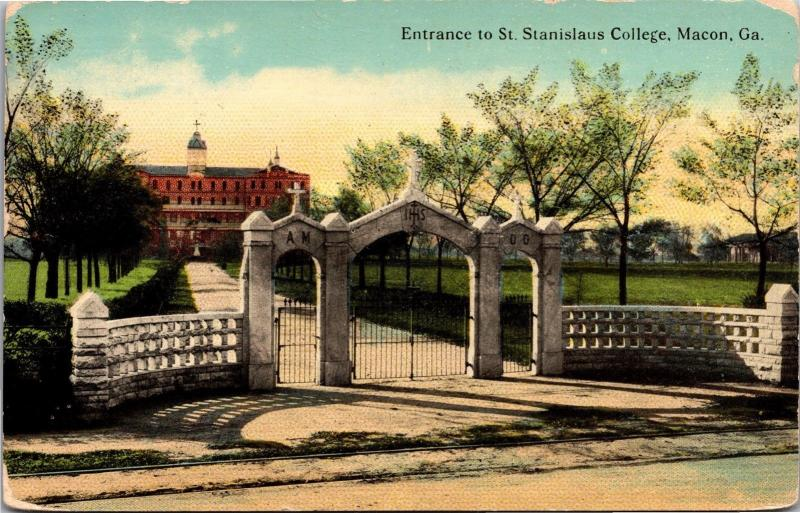
The Stanislaus neighborhood was once home to St. Stanislaus College, a Jesuit novitiate dedicated to the formation of young men entering the Society of Jesus. Originally founded in 1874 as Pio Nono College—named for Pope Pius IX—the institution was shaped by the Jesuits amongst anti-Catholic sentiment, and anti-Irish sentiment in particular. It’s no surprise, given that one source places non-Catholics outnumbering Catholics in Georgia sixty to one at the time. This is according to the Jesuits USA Central and Southern Province, who write that the institution was colloquially known, “perhaps in a chiding manner, as the Irish High School.”1
Those in attendance were trained in prayer, classical studies, and the discipline of religious life. That formation was tested on November 7, 1921, when a fire broke out and consumed the school. The Jesuits write that the men had just finished Benediction of the Blessed Sacrament and eaten supper when they smelled smoke. The blaze spread so quickly that efforts to contain it proved futile. The school sat back on a hill without running water, and the entire structure was ultimately destroyed, along with a great loss of objects of historical and religious significance. By the grace of God, no lives were lost, and the now-homeless Jesuits were welcomed warmly by Macon’s generally anti-Catholic community.
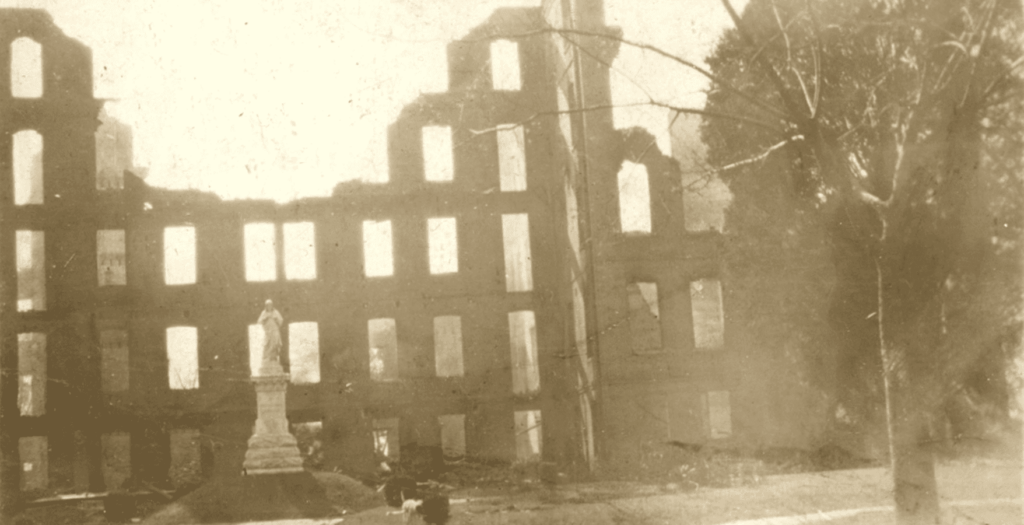
The novitiate was not rebuilt. In time the Jesuits relocated, the property was sold, and a residential neighborhood eventually rose in its place, still bearing the name Stanislaus. Buildings may be lost, but the shaping of persons in truth, responsibility, and fidelity endures in those who were formed there and in those who come after them, under their own particular conditions for holiness.
Images from the fire are evocative, and one wonders where the statue of Our Lady (see above) ended up—she stands proudly in the rubble, protective, the one solid in a sea of now-empty windows.
St. John Paul II is the patron of Paloma & Fig. Gladly, we inherit his New Evangelization. As we continue to develop the debut issue of Resona, we find ourselves examining our relationship not only to our own patron but to this particular place: Macon, a rare gem of Catholic history in the heart of Georgia. The earliest recorded baptisms east of the Mississippi took place on the Ocmulgee River, administered by Franciscan friars. Georgia’s history of Jesuit and Franciscan missionaries culminates in our five Georgia Martyrs, who, according to the Diocese of Savannah, “labored with remarkable courage and devotion to evangelize the native peoples of the region,” with whom they lived peacefully. “Tens of thousands were baptized, catechized, and provided the sacraments.”2
The three-pronged project of Paloma & Fig, A Resounding Yes!, and Resona all emerge foremost from this place. We hold everyday life dear as a place for evangelization and witness—and everyday life is inseparable from its surroundings, from the soil and the streets and the saints who have already prayed, worshiped, loved, and lived here.
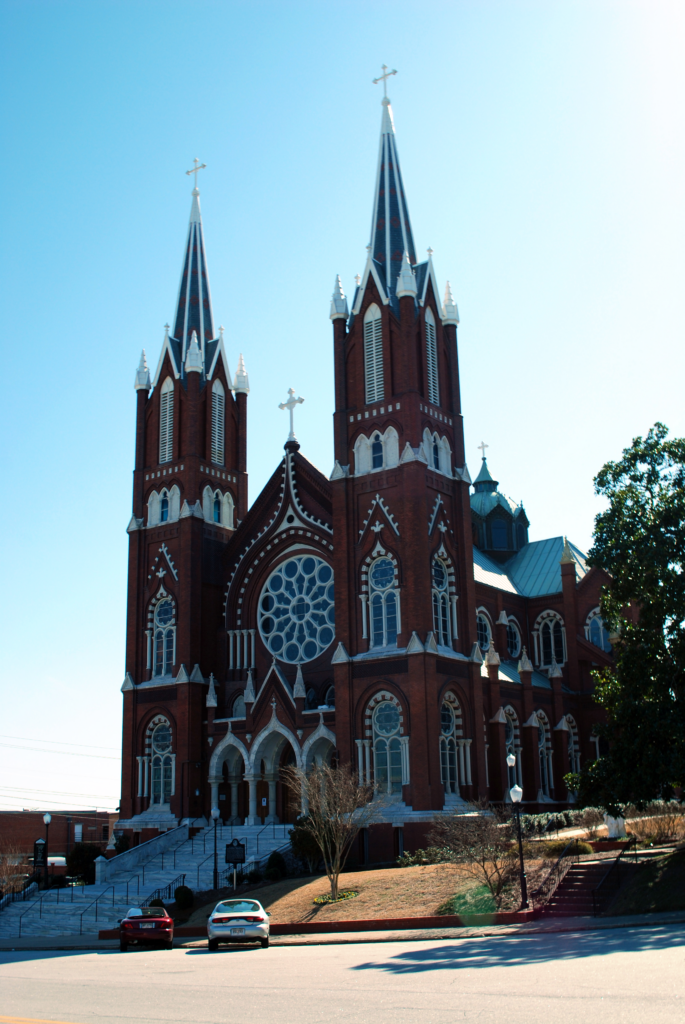
We love John Paul II because he understood this. He knew that holiness is not an abstraction achieved at a remove from ordinary life but is found in its particulars. And he knew that what animates the particular is always the universal: the Holy Spirit, whom he described as “Person-Love” and “Person-Gift.”3The personal expression of God’s self-giving, the inexhaustible treasure at the center of all that is. It is this Spirit, he reminds us, who makes known to us the depths of what it means to be a person made in God’s image. It is this Spirit who enters chaos and makes of it something unified.
We invoke John Paul II as our patron because he teaches us, by his life and by his thought, to receive the gift that we are, to recognize the gift in those around us, and to offer back to God, through ordinary work, the love that is the source of that gift. May he and St. Stanislaus both pray for this work. May their witness continue to shape what we are trying to build here in Macon, Georgia.
Let yourself be charmed by Christ, the Infinite . . . Fall in love with Jesus Christ, to live his very life, so that our world may have life in the light of the gospel.
—Pope St. John Paul II
- “Lost in Flames: Remembering the St. Stanislaus Novitiate of Macon, Georgia” ↩︎
- The Cause for Canonization for the Georgia Martyrs ↩︎
- Dominum et vivificantem ↩︎

Lead Editor Franci Revel Eckensberger holds a Master of Fine Arts in Poetry from Cornell University. With years of experience as a copyeditor for academics, fellow writers, and various small businesses, she takes pride in maintaining clarity, consistency, and beauty in each client’s voice.
Franci finds grace and insight in the Catholic Church’s rich relationship to language and invites that relationship to influence both her literary and editorial work. Saint Cecilia and Catherine of Siena continue to play a vital role in her journey to the faith as an artist. She lives in coastal Delaware with her husband and daughter.
Leave a Reply


access for free →
These professionally crafted, spiritually-inspired templates will help you create scroll-stopping posts in minutes. Skip the design struggle and share your message beautifully. Customize in Canva, post and get noticed. And yes, it's totally okay to swipe these!