
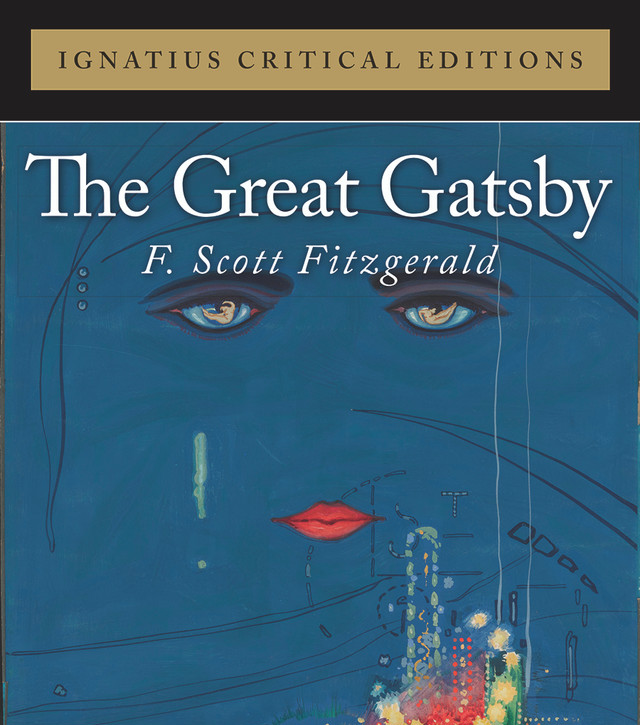

The Hidden Story: Ignatius Critical Edition’s
The Great Gatsby
By Colleen Dean, Contributing Writer
If someone had told my younger self that my eleventh-grade English class could be redeemed by uncovering hidden themes of Catholicism and Truth in secular novels, I probably would have laughed. Public school teachers rarely took that leap. But the Ignatius Critical Edition of The Great Gatsby does exactly that.
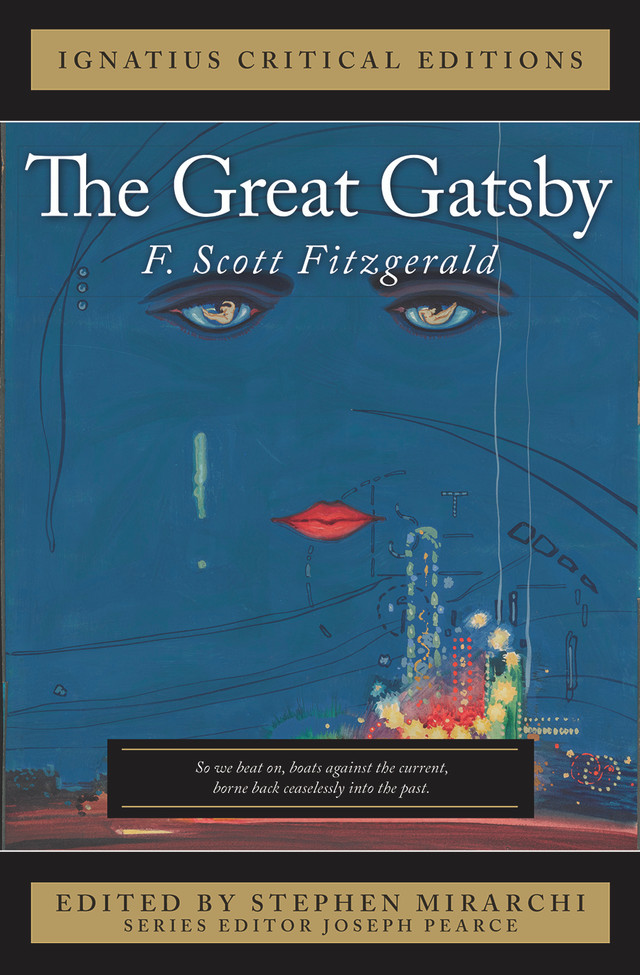
Beginning with an introduction by Stephen Mirarchi, the book acknowledges F. Scott Fitzgerald’s Catholic upbringing and argues that, despite never explicitly referencing his faith in the novel, The Great Gatsby “presents morality in supernatural terms.”1 This unique edition annotates the novel with Scriptural allusions and includes three scholarly commentaries that illuminate the spiritual and moral questions subtly woven into the story.
The Great Gatsby is undoubtedly one of the most celebrated works of twentieth-century American literature, offering a vivid portrait of the unfiltered debauchery of the Roaring Twenties. On the surface, it hardly seems like a Catholic novel. Following a plot lined with greed, adultery, and tragedy, Jay Gatsby experiences tremendous misfortune in his pursuit of elusive romance and the American Dream.
Yet beneath the glamour and decadence lies a deeper question: What happens when we place our faith in something other than Truth?
Fitzgerald’s characters spend much of the novel chasing illusions and fleeting satisfaction, and when these facades fall away, the reader is left with a stark reality not unlike the Catholic perspective. Human nature longs for fulfillment, but the temporary satiations of earth pale in comparison to the permanent fulfillment of our hearts.
James Como
Professor of Speech, Rhetoric, and Public Communication
York College of the City University of New York
Como poses a seemingly simple question: “What is The Great Gatsby really about?”
To answer it, he draws on literary expert I.A. Richards and Dante himself to break down the levels of literary analysis.
Richards divides the meaning of a novel into sense, feeling, tone, and intention. Dante, in his Convivio, focuses on four levels: literal, allegorical, moral, and anagogical. Together, these frameworks help Como uncover the deeper layers beneath Fitzgerald’s novel.
Jay Gatsby is no saint. The supporting characters themselves are murderers, adulterers, and swindlers, and Gatsby himself is deeply entangled in the sordid affairs of passions and material pursuits. Yet Fitzgerald somehow persuades us to sympathize with him.
This is significant in the way that Fitzgerald calls upon us to empathize. Gatsby’s flaws do not erase his humanity and his need for mercy. We as readers are to recognize the innately human struggle to find true happiness and are called to love him as our neighbor.
Como suggests that Fitzgerald’s omission of Gatsby’s struggle as explicitly religious is significant, as it allows spiritual themes to organically emerge through symbolism and each character’s desires. The famous green light becomes more than a symbol of longing for Daisy; it becomes a symbol of human yearning itself. Gatsby reaches for something beyond himself but is tragically misdirected towards a finite object rather than the eternal One.
Robert C. Evans
I.B. Young Professor of English
Auburn University at Montgomery
Evans focuses on one of the most overlooked moments in The Great Gatsby: the Michaelis episode.
Michaelis, George Wilson’s young Greek neighbor, becomes an unexpected eyewitness to Myrtle’s murder and acts as a source of comfort for the devastated Wilson. Though his appearance is brief, Evans argues that Michaelis’ presence in the novel serves a surprisingly significant purpose.
Michaelis’ actions highlight a striking contrast with the main cast. While many characters, including the narrator Nick, remain consumed by their own self-interest, Michaelis displays genuine empathy for another human being. This contrast “helps suggest the relative shallowness of Nick and Jorden, neither of whom expresses any concern for Wilson.”2 Michaelis may be one of the few characters who demonstrates authentic charity. In a novel dominated by inward desires, this brief act of outward compassion marks a rare and welcome exception.
Whether Fitzgerald intended it consciously or not, Michaelis serves as a reminder that goodness still exists amid moral chaos. Each character is so deeply flawed, it is almost naive to think selfless compassion could occur in such a state. But Michaelis’ appearance occurs just long enough to draw our attention away from the passionate affairs of Gatsby and company long enough to remind us of something larger than ourselves—empathy and charity.
Aaron Urbanczyk
Professor and Department Chair of English
Franciscan University of Steubenville
This commentary was especially enjoyable for me because Urbanczyk teaches in the Catholic Studies graduate program that I completed at Franciscan University. His commentary explores the romantic consciousness shared by Gatsby and Nick. Gatsby pursues Daisy with religious devotion, while Nick finds himself enthralled by the glamour and mystery surrounding Gatsby’s life.
“The making of Jay Gatsby is an etiology of romantic desire.”3
One of the key elements of this analysis is the exploration of desire itself. Gatsby’s tragedy is not that he desires too much, but that he desires the wrong thing. His longing takes on an obsessive intensity that is almost spiritual to him, yet it is directed toward Daisy rather than towards something above himself.
This insight aligns closely with a Catholic understanding of the human person. We are made for fulfillment beyond the material world, yet we frequently mistake earthly goods for the ultimate Good. Gatsby’s dream becomes a tragic tale about misplaced worship.
Overall, the Ignatius Critical Edition of The Great Gatsby succeeds in its endeavors because it does not force Catholic themes onto Fitzgerald’s novel. Instead, it helps reveal preexisting themes to its readers, like that of Truth versus illusion, heightened moral responsibility, and authentic love.
Learn more about Ignatius Critical Editions here and click the book cover above to purchase this edition of The Great Gatsby.
- Stephen Mirarchi, Editor, The Great Gatsby (Ignatius Critical Editions), xvii. ↩︎
- Mirarchi, 188. ↩︎
- Mirarchi, 202. ↩︎

Colleen Dean is passionate about evangelizing secular culture through the written word. She holds a bachelor’s degree in Political Science and a master’s degree in Catholic Studies from Franciscan University of Steubenville. Her work has been published in The Washington Examiner, The College Fix, and Lone Conservative.
Colleen lives in Ohio with her husband and son. In her free time, she enjoys exploring nature and spending time with her family.
Leave a Reply


access for free →
These professionally crafted, spiritually-inspired templates will help you create scroll-stopping posts in minutes. Skip the design struggle and share your message beautifully. Customize in Canva, post and get noticed. And yes, it's totally okay to swipe these!