
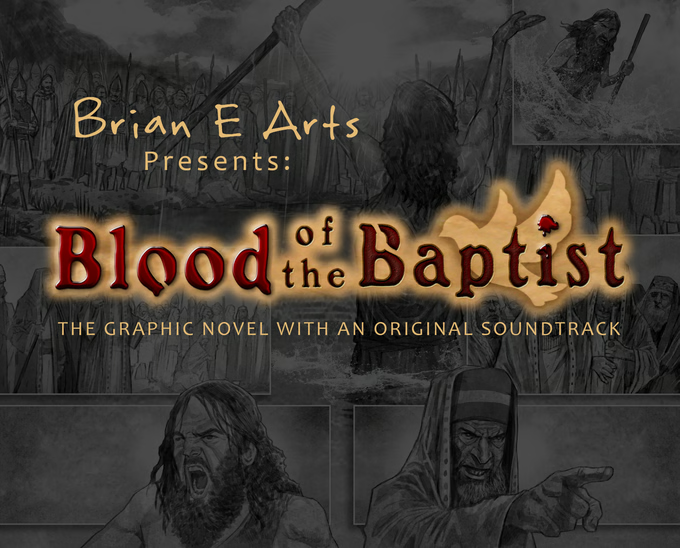

Blood of the Baptist:
An Exclusive Interview with Brian E. Lau
By Franci Revel Eckensberger, Lead Editor
We are blessed to be in conversation with Brian E. Lau about his latest multimedia project—Blood of the Baptist, which “tells the tragic and heroic story of John the Baptist, the last Old Testament prophet, whose radical faith and fearless devotion to God sparked a revolution that forever altered the course of history.” The project has attracted GRAMMY and Dove Award-winning artists from hit productions like The Chosen and House of David, who expand the world of the graphic novel into a full-length album and music video experience.
Blood of the Baptist is being funded on Kickstarter. If the funding goal is reached, at least 100 copies will be donated to prison ministry, and the project is exploring ways to bring the soundtrack and music videos to incarcerated audiences, as well. You can be a part of bringing this project to life and supporting this ministry here.
About Brian E. Lau
Brian E. Lau is the creator of distinctive graphic novels that fuse dynamic storytelling with custom-composed soundtracks.
His titles include the mind-bending sci-fi saga Staunch Ambition, which explores what happens when human innovation transcends its physical limitations. His soon-to-be-released Biblical epic, Blood of the Baptist, offers a dramatic look at the life and death of the Prophet John the Baptist. Meanwhile, his flagship title, Inferno City Firehouse, blends true stories of real Detroit firefighters into a breathtaking narrative and donates a portion of profits to PTSD and mental health causes.
Brian has collaborated with top-tier talent across multiple mediums, working with renowned comic artists like Clayton Crain, Freddie Williams II, Khoi Pham, and Erwin J. Arroza to bring his graphic novels to life. In music, he has partnered with GRAMMY and Dove Award-winning musicians, including Michael Iskander (King David on House of David), Cindy Morgan, Matthew S. Nelson (Composer for The Chosen), Reina Özbay (Abigail on The Chosen), Troubadour Adam Road, and Quinten Coblentz.
His work has also been featured on major podcasts such as The Babylon Bee, Comic Book Club, and Comics, Beer & Sci-Fi.
Blood of the Baptist
Paloma & Fig: The Kickstarter for Blood of the Baptist describes St. John the Baptist as an “extreme radical” and “one of the world’s greatest original rebels.” Can you speak to these characteristics and why this specific story was one you wanted to tell?
Brian Lau: John the Baptist was something of a rock star in his day. He attracted enormous crowds, challenged the powerful, and inspired a movement. Yet despite his extraordinary influence, he possessed the humility to declare of Jesus, “He must increase, but I must decrease.”
What fascinates me most, however, is the apparent scandal of his fate. Here was a man preparing the way for the Messiah, only to find himself imprisoned while Jesus was out performing miracles, healing the sick, and dining with sinners. Yet Jesus never came to rescue him. Imagine how bewildering that must have seemed at the time!
Of course, we now understand that Jesus would ultimately endure an even greater suffering and sacrifice. But exploring that tension, and the extraordinary faith required of John, is what drew me to his story. And then there’s the sheer brutality of his death. John’s life culminates in one of history’s most shocking executions: his beheading, with his head served on a platter. It’s a tragedy worthy of a Greek epic, except this was no myth. This is history.
P&F: Why a graphic novel? What do you think this medium can accomplish that, say, a novel could not, especially for this story?
BL: First, I’m a Christian. Second, I’m a geek!
I’ve loved comic books since childhood, and I’m equally passionate about movies, television, and art in all its forms. For me, a graphic novel brings those worlds together. It’s visual storytelling with the freedom to create something truly cinematic.
There’s a reason so many successful films have originated in comics and graphic novels. The artwork functions like a storyboard for a film.
When I write, I’m already envisioning the scenes as a movie. My goal is to create a visually captivating graphic novel that stands on its own while laying the foundation for what I hope will eventually become a feature film.
P&F: How did you arrive at the decision to tell John the Baptist’s story through multiple mediums? What creative challenges or difficult decisions did you face in bringing your experiential vision to life?
BL: Ever since childhood, I’ve tinkered with the piano, composing little melodies with my very limited abilities. I could always imagine how wonderful they might sound in the hands of a talented musician!
Eventually, I began collaborating with professional musicians to bring those ideas to life, incorporating original soundtracks into my previous graphic novels. It turned out to be one of the best creative decisions I’ve ever made.
With Blood of the Baptist, that ambition grew considerably. Working with extraordinary musicians, including one of my favorite Christian artists, Cindy Morgan, the music began taking on a life of its own.
The songs became so powerful that I felt they deserved music videos, which offered another opportunity to explore the story’s themes and characters.
Bringing all these artistic disciplines together without compromising quality has been extraordinarily challenging. It adds an enormous amount of time, work, and expense to the project, but I believe it adds exponentially more artistic and emotional value. It’s a tremendous undertaking, but seeing everything come together has made the sacrifices worthwhile.
P&F: How do the music, artwork, and storytelling all inform one another in this project?
BL: The story is the foundation. Everything else grows from it.
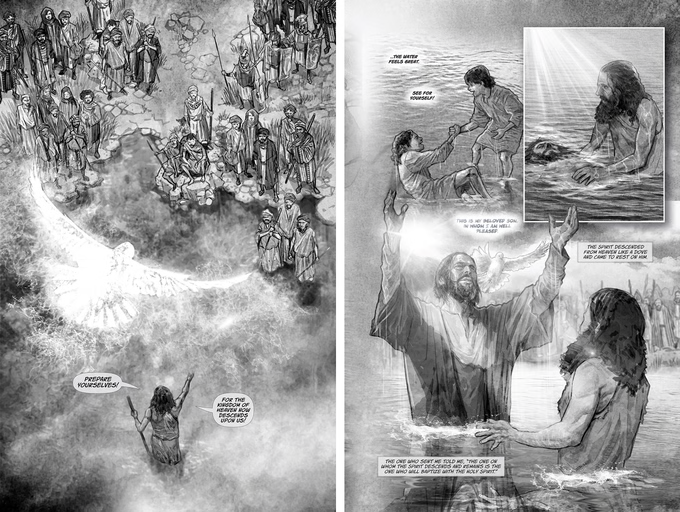
When I’m writing, I envision the story cinematically. The artwork brings that vision to the page, while the music explores the emotions and spiritual themes beneath the surface.
A song can capture something about suffering, redemption, or the longing for love that might be difficult to communicate through dialogue alone. And the music videos bring another dimension to those themes through performance and visual storytelling.
My hope is to eventually bring Blood of the Baptist to the screen, and that cinematic ambition certainly influences my creative approach. But the graphic novel, soundtrack, and music videos are artistic experiences in their own right, each created with the same commitment to excellence.
Each medium should stand beautifully on its own, but together they create something even more powerful.
P&F: What was it like to collaborate with so many talented voices, artists, and experts on this project?
BL: It’s been one of the greatest blessings of my creative life.
I’ve had the privilege of working with Grammy and Dove Award-winning musicians, but I’m every bit as excited about collaborating with extraordinary artists who are still establishing themselves. Great talent exists at every stage of a career.
What’s been especially remarkable is how deeply these artists have connected with the vision of Blood of the Baptist.
Even our favorite musicians don’t produce a masterpiece every time they create something. But somehow, the people involved in this project have consistently tapped into its emotion, drama, and spiritual depth, producing work that I find genuinely powerful and captivating.
As the creator, there’s nothing more exciting than watching someone take an idea you’ve imagined and transform it into something even more beautiful than you envisioned.
P&F: This project is extremely ambitious, and the response on Kickstarter is very promising. Do you think we are at a particularly opportune moment for ambitious, artistically excellent Christian media? What do you think is driving that interest?
BL: Absolutely! Just look at what’s happening with productions like The Chosen, House of David, and the growing success of faith-based entertainment.
Christian music has also developed into an extraordinary industry, with exceptional artists working across virtually every musical genre.
But what’s particularly interesting to me is that Christianity has inspired the greatest works of art, literature, architecture, and music in Western civilization. Somewhere along the way, much of contemporary Christian entertainment seemed to lose that ambition.
I believe we’re witnessing a renewed appetite for stories that are both spiritually meaningful and artistically exceptional.
Faith and artistic excellence should never be competing priorities. If anything, our faith should inspire us to pursue the highest possible standards of creativity and craftsmanship.
P&F: Jimmy Akin serves as the historical and biblical expert for Blood of the Baptist. We know very little about John the Baptist’s interior life. How did Akin help build an urgent narrative grounded in Scripture?
BL: I’ve spent years researching Scripture and developing this story, but I also recognize the importance of having someone with Jimmy Akin’s extraordinary biblical and historical knowledge helping me navigate the details.
Jimmy serves as a consultant, reviewing my ideas, answering questions, identifying potential inaccuracies, and occasionally offering creative suggestions of his own. His feedback has been invaluable.
My goal was never to invent a different John the Baptist. It was to explore the John we know from Scripture, using historical fiction to illuminate and emphasize the truths we already know about his life.
The fictional elements are there to serve the truth, not replace it.
That’s an important distinction, especially when you’re telling a story about someone as significant as John the Baptist.
P&F: Do you have any advice for makers who want to create faith-based writing or art, but feel intimidated or lost when they sit down to start?
BL: Be inspired. And don’t be afraid to be a little naive!
I began my creative journey with enormous enthusiasm and very little understanding of just how difficult it would be. In some ways, that ignorance was a blessing. Had I known everything I was getting myself into, I might never have started!
Orson Welles spoke about the tremendous advantage of approaching something without being constrained by all the established rules. I can certainly relate to that.
But there’s an important distinction between being naive and being careless. I’ve worked my tail off learning how to do things professionally, making plenty of mistakes along the way.
Ultimately, I believe great art begins with inspiration, with something beautiful or profound that you’re compelled to share.
And you’ll need that inspiration, because creating something worthwhile is hard. It requires sacrifice, perseverance, and a willingness to suffer for what you love.
There’s a reason the word “passion” is rooted in suffering.
P&F: Beyond the material benefits, what do you hope contributors experience by helping fund this project on Kickstarter?
BL: I hope they experience the satisfaction of helping bring something into the world that might genuinely change someone’s life.
That’s what great art can do. A beautiful song, a powerful story, or a moving image can reach someone in a way that ordinary conversation sometimes cannot. It can open hearts and minds, inspire courage, and offer hope when it’s needed most.
One of the central themes of Blood of the Baptist is finding hope in suffering.
My greatest hope is that the story and music will reach people who need that message, perhaps at a particularly difficult moment in their lives.
And I hope our backers will feel proud knowing they helped make that possible.
P&F: What do you hope readers will take from Blood of the Baptist, about John the Baptist himself, their own faith, or what sacrifice and faith can do for the world today?
BL: John the Baptist’s life is an extraordinary example of courage, humility, and unwavering devotion to God. He attracted enormous crowds and wielded tremendous influence, yet he willingly stepped aside when his purpose had been fulfilled.
And that purpose was to point people toward Jesus Christ, the Messiah, and the hope of salvation.
John’s story is also one of profound suffering and sacrifice. From the darkness of his prison cell, he could not have seen the full significance of what his life and death would mean to the world.
But two thousand years later, we can.
I hope readers come away with a deeper understanding of John the Baptist, but also with renewed hope in their own struggles. Suffering doesn’t necessarily mean that God has abandoned us. Sometimes its purpose is far greater than we can possibly comprehend.
And ultimately, I hope this story points people toward the same person John spent his life preparing the world to receive: Jesus Christ.
Thank you to Brian Lau for discussing this beautiful project with Paloma & Fig and for all the work he and the team of Blood of the Baptist are doing in service of bringing the light and love of Christ to the world. Visit the Kickstarter here.
Leave a Reply


access for free →
These professionally crafted, spiritually-inspired templates will help you create scroll-stopping posts in minutes. Skip the design struggle and share your message beautifully. Customize in Canva, post and get noticed. And yes, it's totally okay to swipe these!