
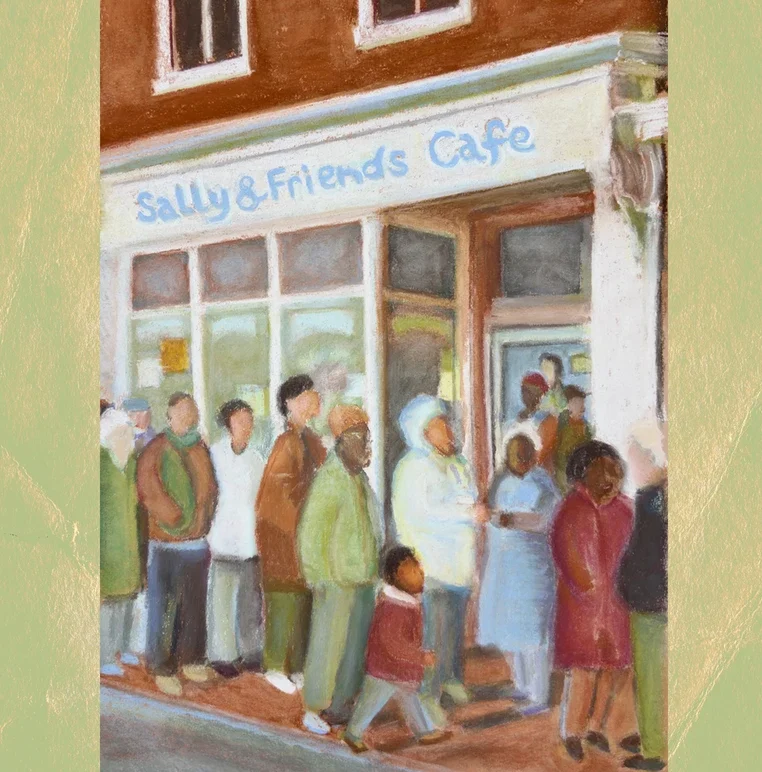

Help My Unbelief: Miss Sally’s Son
By Colleen Dean, Contributing Writer
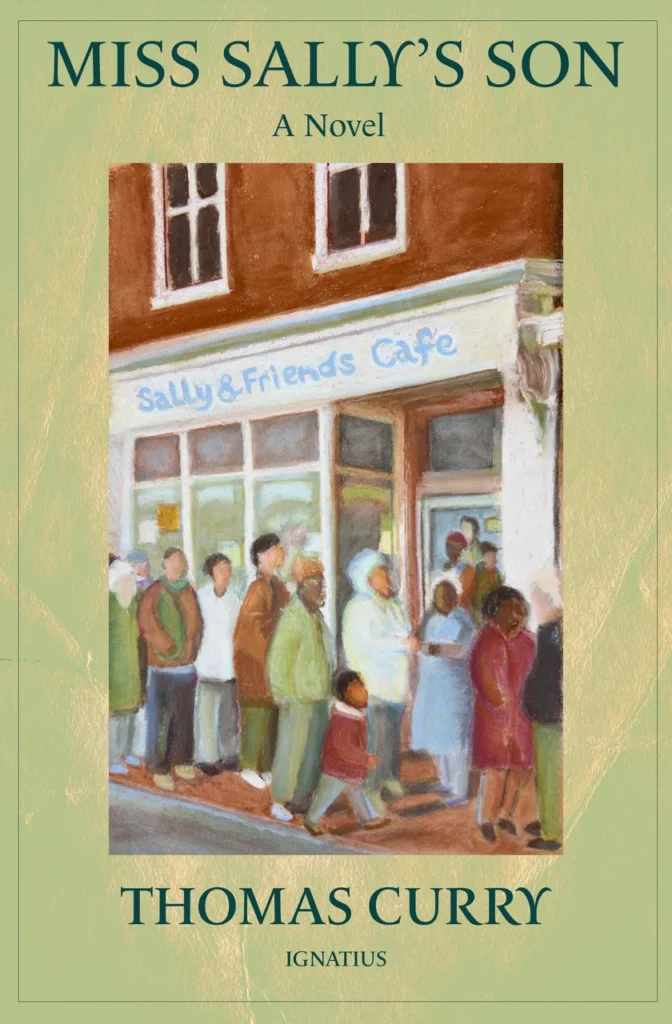
For those seeking a theological story of truth, love, and faith—but aren’t quite ready to sit down with St. Augustine’s Confessions—Thomas Curry’s Miss Sally’s Son (Ignatius Press) is a compelling alternative.
Curry himself describes the novel as a way to reach audiences who might otherwise not be open to reading about the Catholic faith, writing that his “goal in writing has always been evangelization, believing that fiction speaks to a different ear than serious theology.”1
Miss Sally’s Son tells the story of Jack Benton, a young, successful lawyer who has fallen away from the Catholic faith. After the untimely death of his mother, Miss Sally Benton, Jack returns home from Berlin, Germany, to Williamsburg, Virginia, to settle her estate. During this time, he uncovers the truth about the identity of his father and how he came to be raised by a single mother.
More importantly, Jack begins to confront deeper questions about himself and the existence of God. Because much of the novel is written from his perspective, the reader gains insight into the methodical questioning of someone seeking to understand Truth through reason.
One aspect of the novel that resonated deeply with me was Jack’s refusal to pray, “Lord I believe; help my unbelief.” Despite encouragement from priests and friends, he resists praying these words until he can say them with full conviction—until he truly believes.
“I can say a prayer all I want, but if there’s a God, He knows I don’t believe.”2
Jack’s matter-of-fact worldview is further challenged as he encounters his mother’s chosen family in Virginia: a law student named Mony and her seven-year-old daughter, Sae. Mony’s mother, Carolyn, also lives with them in Jack’s mother’s house and works as a cook at Miss Sally’s cafe. Together, they bear witness to the strength of love amid a broken world and to the ever-present centrality of the Catholic faith in their daily lives.
Jack is immediately drawn to Mony, yet both hesitate to pursue a relationship due to their differences in faith. Mony must consider her daughter, for whom any man would become an immediate father figure. Jack, meanwhile, is open to rediscovering Catholicism, but worries that his attraction to Mony might compromise the sincerity of any potential conversion.
Though their romance remains largely restrained for most of the novel, Jack and Mony form a deep emotional bond as he continues his search for truth about his father and the faith. He begins attending Mass again, and when the Rosary is prayed at his mother’s vigil, “[t]he prayer came as naturally to him as breathing . . . he felt an unexpected and deep sense of the peace and comfort he had felt as a child, tucked into his bed with his mother kneeling at his side..”3
This tension between nostalgia and identity is central to Jack’s story. His return to the faith cannot rest solely on childhood memories; it must be founded upon who he is now as a man. For many, Catholicism is intertwined with their childhood—so often set aside as adulthood begins. Jack reflects this reality throughout the novel.
The secular world comes knocking repeatedly to distract him in the most inconvenient ways. Through ongoing crises at the Berlin office, these interruptions from his former life feel familiar and compelling to Jack, at times making it seem as though he will abandon his ongoing spiritual search in favor of what is known.
Yet subtle changes do begin to take hold. When a work crisis arises on a Sunday, shortly after attending Mass with Mony and Sae, Jack is hesitant to disturb his colleagues. Their casual response—that they had no plans that day—highlights a growing shift in his own perspective. It’s a small moment, but it reveals the quiet reordering of his priorities.
Jack’s journey also requires him to confront the story of his father, Thomas Phillips. Once a wealthy young man and self-proclaimed womanizer, Thomas gets Jack’s mother, Sally, pregnant before being sent to Vietnam. In his absence, Thomas’s father pressures Sally to have an abortion to “make the problem go away.” She immediately refuses. Instead, an arrangement is made so Sally will live in Williamsburg with financial support to run a cafe and raise her son, on the condition that she never contacts Thomas again.
She keeps this promise, watching from afar as Thomas returns from war wounded and experiences a profound conversion in his hospital room, eventually becoming a monk and theologian. She purchases every one of his books, leaving Jack with the opportunity to learn who his father was through his writings.
This revelation unsurprisingly unsettles Jack’s previously well-ordered life. Accustomed to being in control, he must now grapple with uncertainty and surrender to the unknowns. In doing so, he begins to unconsciously open himself to God.
“You went along thinking you were the master of your own ship . . . and it was all just so much nonsense. A man’s destiny always depended on the destiny of the people around him and the society in which he lived. No one existed in a vacuum where his own ambition, his own independent strength of mind or will, could guarantee a desired outcome.”4
Jack’s reflections like this deepen during a retreat at the abbey where his father spent his final days. In the silence, removed from worldly distractions, he becomes increasingly more attentive to God’s voice: “It seemed to Jack that the goal of modern life was to pack one’s day so full of activities that contemplation was never necessary. After all, life was short . . . Modern society considered life not as a proving ground for the soul but the final word.”5
Yet it is only after returning to his former life in Germany that Jack finally recognizes how profoundly he has changed as a person because of this journey. His Damascus moment hits him like a ton of bricks and he is finally able to pray: “Lord I believe; help my unbelief.”
Jack’s story speaks not only to young people navigating ambition and relationships, but to anyone whose faith has been challenged by prideful temptations. This novel reminds the reader that we are not made for this world, even as society pushes us to treat it as our ultimate end.
Jack’s search for not only determining the existence of a loving God, but pursuing an intimate relationship with Him, provides us with reassurance that the struggle towards authentic faith is real and experienced by many.
“It was true, [God] could make us believe, but He had already created cattle, and He didn’t want more of them.”6
God created us with free will, with the choice to believe in Him or not. Whether we find ourselves in that place by grace, through reason, or both, we, like Jack, can take solace in the community of faith that is the Catholic Church.
Overall, Miss Sally’s Son is a captivating and theologically rich novel that invites us into a profound spiritual journey, ultimately leaving us longing, as Jack does, for an authentic encounter with Truth itself.
Purchase Miss Sally’s Son from Ignatius Press here.
- Thomas Curry, Miss Sally’s Son, 321. ↩︎
- Curry, 85. ↩︎
- Curry, 116. ↩︎
- Curry, 154. ↩︎
- Curry, 218. ↩︎
- Curry, 245. ↩︎

Colleen Dean is passionate about evangelizing secular culture through the written word. She holds a bachelor’s degree in Political Science and a master’s degree in Catholic Studies from Franciscan University of Steubenville. Her work has been published in The Washington Examiner, The College Fix, and Lone Conservative.
Colleen lives in Ohio with her husband and son. In her free time, she enjoys exploring nature and spending time with her family.
Leave a Reply


access for free →
These professionally crafted, spiritually-inspired templates will help you create scroll-stopping posts in minutes. Skip the design struggle and share your message beautifully. Customize in Canva, post and get noticed. And yes, it's totally okay to swipe these!